Friday, 24 June 2016

Party today, but we are not safe yet


Even as I celebrate the Leave vote, my long experience in EU matters keeps this thought hovering in my mind: voting to leave is not the same thing as actually being out. There will be plenty of time in the next few years for the decision to be fudged.

And plenty of people willing to do it. Already today Daniel Hannan as listed Guy Verhoftstadt’s idea of ‘associate membership’ as one of the paths Britain could consider.

Verhoftstadt is the former Belgian prime minister who is the head of the Liberal group in the European Parliament. He is also one of the most active euro-fanatics in Brussels. His idea of associate membership would keep Britain tied as a member of the EU, but with lesser powers.

I expect that sort of thinking from Verhoftstadt. But for Hannan, who knows the Verhoftstadt euro-fanatic principles from his years at the European Parliament, even to suggest this different, second-class membership of the EU could be on a ‘possibles’ list shows muddled--and therefore dangerous -- thinking among Tory eurosceptics.

But those are not arguments for today. Today is the moment for a happy dance. And I'm dancing it.

Tuesday, 21 June 2016

'Leap or no leap' on Thursday


What we have coming up on Thursday is Britain’s Hartford Convention moment.

Not that one person in a million in Britain has heard of the Hartford Convention. That is no surprise, since in America the convention – held in secret in Hartford, Connecticut, 1814 – is almost as unknown.

Of course it is. The narrative of official American history since 1865 has been that the federal union is, and has been since the establishment of the United States, indissoluble.

The problem for official historians – the ones the American writer Gore Vidal used to call ‘the court historians’—is that the evidence of the Hartford Convention shows it was not always so.

In late 1814, the New England States were fed-up with what the War of 1812 against the British (known as ‘Mr Madison’s war,’ after the then-President, James Madison) was doing to their trade.

That was their immediate grievance. Their long-term grievance was over the balance of political power that gave the Southern States, particularly Virginia, the richest of all the States, effective control of the federal government.

Anyone familiar with the early power of Virginia would not be surprised at the grievance: President James Madison was from Virginia, as was his immediate predecessor as president, Thomas Jefferson. Four of the first five US presidents were from Virginia, including of course Washington.

The New England delegates met in secret sessions at the Hartford State House for three weeks to draft a formal protest against the Federal Government’s continued involvement in the war, which allied the United States with France against Great Britain.

They planned to send a delegation to Washington to present their demands, including a Constitutional amendment that would dilute the Southern States’ power to declare war.
If the federal government would not consider their demands, many of the delegates of the Hartford Convention were ready to call for secession.

It was seen as the only way for the New England states to break free of the dominance of the Southern States. The threat was included in diplomatic-speak in the final paragraph of the official resolution to be presented to the government: if the resolution should be unsuccessful ‘it will in the opinion of this Convention be expedient for the Legislatures of the several States to appoint Delegates to another Convention, to meet at Boston, in the State of Massachusetts, on the third Thursday of June next with such powers and instructions as the exigency of a crisis so momentous may require.’

The momentous ‘crisis’ would be a decision for secession. No one was in doubt that the New England states could secede from the Union. The only question was whether they would.

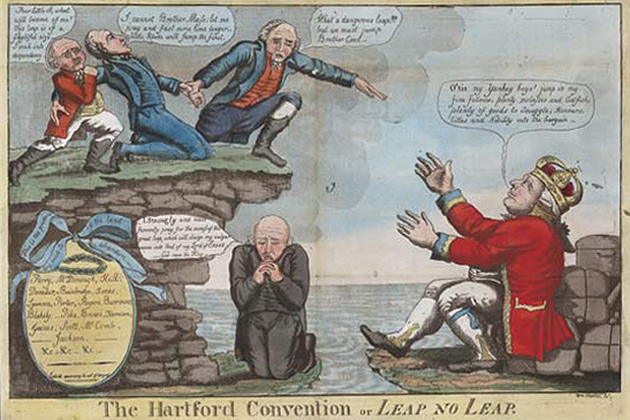
An 1814 political cartoon titled ‘Leap or no leap’ illustrates how the rest of the States viewed the convention. 

Here is how the US Library of Congress describes the cartoon. It shows that the Hartford Convention delegates were viewed as wishing to become British again:

‘The artist caricatures radical secessionist leader Timothy Pickering and lampoons the inclinations toward secession by convention members Rhode Island, Massachusetts, and Connecticut, alleging encouragement from English King George III.’

‘In the centre, on a shore, kneels Timothy Pickering, with hands clasped praying, "I, Strongly and most fervently pray for the success of this great leap which will change my vulgar name into that of my Lord of Essex. God save the King."’

‘On a precipice above him, a man, possibly Harrison Gray Otis, representing Massachusetts, pulls two others (Rhode Island and Connecticut, possibly James Hillhouse) toward the edge.’

‘Rhode Island: "Poor little I, what will become of me? this leap is of a frightful size -- I sink into despondency." Connecticut: "I cannot Brother Mass; let me pray and fast some time longer -- little Rhode will jump the first." Massachusetts: "What a dangerous leap!!! but we must jump Brother Conn."’

‘Across the water, on the right, sits George III with arms stretched out toward the men on the cliff. He calls, "O'tis my Yankey boys! jump in my fine fellows; plenty molasses and Codfish; plenty of goods to Smuggle; Honours, titles and Nobility into the bargain."’

‘On the left, below the cliff, is a medallion inscribed with the names of Perry, McDonough, Hull, and other heroes of the War of 1812 and decorated with a ribbon which reads, "This is the produce of the land they wish to abandon."’

As it happened, while the New England delegation were traveling to Washington, word reached them of the overwhelming victory of General Andrew Jackson against the British forces at the Battle of New Orleans, which indicated the war could soon be over. 


Then on reaching Washington, they learned that the Treaty of Ghent had been signed between U.S. and British diplomats, ending the war.

The Hartford Convention delegates returned home. Their cause was dead in the water.

But their lesson lives on, and we will see it still lives on come Thursday: Just because no one doubts the right of a sovereign State to withdraw from a political and economic union today, doesn’t mean that next year – or next decade – that right will still be respected.

In 1814, the New England states freely declined to exercise their right to leave the Union. Some decades later, the Southern States chose not to decline that right...and while what happened next is a story for another day, the Hartford Convention remains a lesson for today.


Saturday, 18 June 2016

On the way out? Juncker and his, ahem, 'health issues'


Christine Lagarde and the IMF have decided to ignore the truce on campaigning until next week. No one can be surprised. Their latest warning is in the link below, if you can rouse any interest. 


I doubt the threats will have much effect. At this point, people have already been scared into wanting to stay, or determined to want to leave.

I will say nothing of the effects of the killing of Jo Cox on any of it.

Instead I will tell you about a piece on Jean-Claude Junker, president of the European Commission, which was published in Politico.eu on Thursday. For obvious reasons it was swept aside in the news coverage of the day. 

http://www.politico.eu/article/the-time-of-jean-claude-juncker-troubles-european-commission-president-investment-plan-travel-meetings-scheduled/

You might first want to see the 2015 video, link below, of Juncker at the European Council meeting in Latvia, giving the appearance of someone who had had too much to drink. 


The clip shows him backslapping – or ‘bitch-slapping’ as the internet has it -- and hugging various embarrassed politicians, then hugging the Hungarian prime minister and calling him ‘Dictator.’


None of this was any surprise to those of us who enjoyed the late night press conferences Juncker gave during the euro crisis. He was head of the eurogroup. And while other eurocrats such as then-Commissioner Olli Rehn gave answers as calculated as a Japanese robot, the apparently well-oiled Juncker often said far more than any communications officer would have advised. 


Which is why this tearing down of Juncker’s reputation in what is quickly turning into the EU house paper (the Brussels chief of Politico is an ex-spokesman at the Commission) is significant.

Maybe the sober, calculating lot at the top of the European Project have had enough of it, enough of the brandy-soaked joker stuff – sorry, the ‘personal health issues’ -- and also enough of the crisis pile-ups outside the EU institutions.

Certainly the Politico headline would fit that plotline: ‘The time of Juncker’s troubles: Political missteps, personal health issues, doubts about effectiveness and rising Euroscepticism impair Commission chief’s self-declared mission to save the EU.’

Politco lists the areas in which Juncker is ‘grasping for answers.’

‘On a range of fronts, from border fences to Brexit to the economy, Juncker’s Commission has struggled to plough a path out of the malaise. Economic priorities — from Juncker’s much-touted €315 billion investment plan to a transatlantic free-trade pact — have yet to show significant impact or have been derailed.’

‘Interviews with more than 40 EU politicians, diplomats and officials from countries across the EU — critics, supporters, and members of Juncker’s inner circle — as well as an analysis of his travel and meeting schedules, reveal a Commission president who is increasingly on the sidelines.’

‘…The decline in Juncker’s standing over the past 19 months has been so precipitous that the debate in some national capitals has shifted from what to do about it to whether it really even matters.’

‘“The truth is we don’t see him,” a senior diplomat from a large EU country said. “People don’t complain here because he is not indispensable to the everyday functioning of the EU. We sometimes don’t notice his absence.”’

‘…To be fair, the odds were stacked against the longtime Luxembourg premier from the outset. He took over the Commission at a time when Europe was still reeling from the trauma of the debt crisis. The debate over German-inspired austerity for wayward economies had deepened a north-south divide on the Continent.’

‘Yet it was Juncker himself who promised to upend the way things were done, to reinvigorate Europe. The man who earned the nickname “Mr. Euro” for helping to steer the eurozone through the shoals of the debt crisis vowed to use his magic touch on the EU. “I’m allergic to the division in north and south, small and big, weak and strong,” he said at the time.’

‘What’s missing from the Juncker Commission, critics say, is an overarching strategy. Political calculation and short-term tactics, whether the issue is France’s deficit or refugees, drive the agenda. Rather than fixing a north-south divide, his migration policies have deepened an east-west one.’

All in all, Juncker looks like a dead man walking.

Which, if the UK fails to escape the EU, is at least some consolation. What Britain does not need is an effective, active head of the EU executive.

On the other hand, Berlin has not failed to grab the chance to fill the executive power vacuum.


Tuesday, 14 June 2016

How a prime minister drowning in Brexit may yet turn to EEA-EFTA


This could be a game changer: Richard North outlines today in his EU Referendum blog the way the EEA-EFTA option would offer Britain the chance to stay in the Single Market, yet control EU immigration.

If Britain goes for a Leave vote on the 23rd, this becomes one very important piece of information. A panicked Cameron may realise that since he has been ordered by the voters to take the UK out of the EU, he must after all embrace the Norway Option he has denigrated throughout the campaign.

That, or face chaos.

So this little-known but enticing power for Britain to control immigration – yet stay in the calm waters of the Single Market – may suddenly start looking like a political lifeboat for a drowning prime minister.

What the EEA-EFTA option offers Britain – while EU membership does not – is control of immigration through a quota system.

This is not speculation. There is precedent for it. The details are in the link to eureferendum.com below, of how Article 112 of the EEA Agreement and subsequent decisions has allowed Liechtenstein to control the influx of EU migrants.


As North points out, the arrangement is effectively permanent.

Some of us who have been writing on this issue have pointed to Article 112 in the past, and explained the powers this gives any EEA member state who decides to use it. Just to remind, here is the text:

Article 112

1.If serious economic, societal or environmental  difficulties  of  a  sectorial  or  regional  nature  liable  to  persist  are arising,  a  Contracting  Party  may  unilaterally  take  appropriate  measures  under  the  conditions  and  procedures  laid down in Article 113.

2. Such safeguard measures shall be restricted with regard to their scope and duration to what is strictly necessary in order to remedy the situation.  Priority shall be given to such measures as will least disturb the functioning of this Agreement.

3. The safeguard measures shall apply with regard to all Contracting Parties.

So, a contracting party ‘may unilaterally take appropriate measures’ under procedures laid down in Article 113. Unfortunately for the contracting parties who are members of the EU as well as members of the EEA, the procedures say it is the European Commission who will take the action for them – which is no kind of unilateral action at all. 

Only Iceland, Liechtenstein and Norway have the power to act on their own initiative.

This power of initiating action of course covers more powers than just the power to control immigration. It covers among other things all Four Freedoms of the Single Market – the free movement of goods, capital, services and people.

About these Four Freedoms: what is notable here, besides Liechtenstein’s proven ability to control immigration while still being in the Single Market, is that Iceland, despite being bound by the EEA Agreement to guarantee freedom of movement of capital, unilaterally put capital controls in place in 2008 following the banking crisis (last year the Reykjavik government announced plans for loosening the controls -- its economy has recovered spectacularly).

Iceland could stop the free movement of capital because of Article 112 of the EEA Agreement and that key word, ‘unilaterally.’

Iceland has to report regularly to one of the joint EU-EEA-EFTA committees about why it was persisting with capital controls, but there was no doubt it has the right to suspend this ‘freedom.'

In 2015 I asked an official well-placed to know these things (he did not want to be identified) the following question: if Britain joined EEA-EFTA, could it make the argument that the pressures caused by migration on the NHS, schools, housing, transport and the rest amounted to a crisis so free movement of people had to be suspended for some months?

He replied: ‘It's true, you could do it.’

In short, the UK would have greater power to restrict the four freedoms as an EEA-EFTA member than it has now as a member of the EU.

Yet remember this. No matter how much of an improvement it would be for the UK to be in the EEA-EFTA than in the EU, it should still only be used as a half-way house to full independence.

However, Britain's position for securing a final agreement on control of borders would be stronger when the UK is negotiating from outside the EU, yet is still an EEA-EFTA member. 

In that position, Britain could use Article 112 to suspend free movement of people during the talks, yet still be a member of the Single Market. 

That would be an economically and politically comfortable place to stay until a final deal were struck for a fully independent UK.